By: Gerald Baird– Former Senior Program Manager & Chief Scientist at the U.S. DTRA (Defense Threat Reduction Agency).
Hardened Structures Through the Ages: Threats, Engineering and Survivability
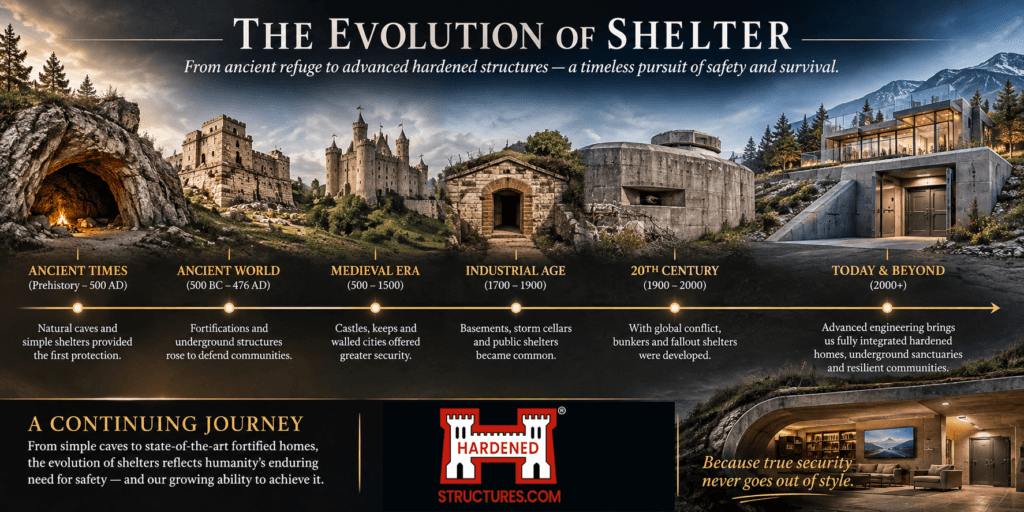
Humankind has sought shelter and safety in hardened structures for as long as it has faced threats from the elements, predators and other people. This is the story of that journey, the engineering and technology involved, and how Hardened Structures can meet those needs now and into the future.
The Ancients
The first hardened structures were underground shelters: the caves our ancestors used for protection from the elements, predators and enemies. Rock offered natural hardness, but the approaches available for modifying it were limited, and early changes were simple, such as blocking or narrowing an entrance. Later cultures learned to work softer rock with better tools and carved vast underground networks. The underground cities of Cappadocia, cut into soft volcanic tuff, are a well-known example.
As populations grew, and as curiosity and the search for food carried people into new areas, they also had to respond to new threats. They employed two of the basic principles of hardened structures: access delay and denial, and ballistic protection. They built surface living structures from easily available, workable local materials such as wood, rocks and earth. Expanding their safe zone further, they constructed walls and barriers outside and around their communal living space.
As knowledge and tools advanced, so did the materials and design of protected surface structures. Simple trees tied together became processed lumber. Local rocks were replaced by shaped blocks of quarried stone, or by locally fabricated bricks and mortar. Over time, better joining methods and mass production made brick and stone masonry a primary means of building surface hardened structures. This enabled much more intricate designs, better suited to their intended use and appearance, with added engineered-in hardness and defensive features.
For much of human history these technologies met the threats of the day. They provided access denial and ballistic protection against ground attack by predators and enemies, and they could withstand kinetic assault by hand-thrown projectiles and by weapons powered by stored tension or torsion energy, such as bows, catapults, and siege engines.
Gunpowder and the Bastion
Gunpowder artillery changed this picture. In 1453 the walls of Constantinople, among the strongest in the world, fell to cannon fire. Tall, thin medieval masonry walls proved vulnerable to this new threat, and engineers responded from the 1500s onward with low, thick, earth-backed bastion fortifications (the Italian trace italienne, aka the “Star Fort”) that could absorb and deflect cannon shot. Refined by engineers such as Vauban, this approach held for centuries, and masonry-faced earthworks remained the standard form of fortification well into the nineteenth century.
The High-Explosive Revolution
This changed again in the late nineteenth century. Rifled artillery had been in use since the 1850s, but advances in chemistry produced powerful high explosives, such as melinite (picric acid) in France around 1885, which could be loaded into elongated, “torpedo-like” shells. During live-fire trials in 1886 at the French Fort de la Malmaison, military engineers discovered that this new combination of weaponry could easily demolish the brick and stone masonry fortifications that were the standard of the day across Europe.
This French revelation, known as the “crise de l’obus-torpille” (the Crisis of the Torpedo Shell), rendered obsolete the main hardened-structure engineering of the time. Fortunately, the nineteenth-century development of Portland cement, patented in 1824 and building on Smeaton’s work on hydraulic lime in 1756, had in effect recreated the concrete known to the Romans but lost since the fall of the Empire, and it was put to quick use. The first applications overcoated existing fortifications with a thick layer of poured concrete, often over a cushion of sand, or faced them with large concrete blocks. This technology of “mass concrete” was used to reinforce existing facilities and to build new ones of mass poured concrete through the turn of the century.
Reinforced concrete, with steel rebar or mesh embedded in the mix, had been developed in parallel from the 1860s, with systems such as Monier’s and Hennebique’s (1892). Its use in fortifications grew in the early twentieth century, although massive, lightly reinforced concrete forts continued to be built and modernized around the time of World War I. Reinforced concrete remains the standard of construction today, along with new concrete mixes of increased strength and other properties.
The twentieth century soon tested these forts. In 1914 the Belgian forts at Liège and Namur, regarded as modern and strong, fell to German and Austro-Hungarian siege howitzers of 305 to 420 mm. Verdun and the other fortified areas of World War I confirmed that mass and burial depth mattered. Between the wars, France built the Maginot Line. In World War II, German U-boat pens, flak towers and the Atlantic Wall relied on very thick reinforced concrete, and the large penetrating bombs of 1944 and 1945, such as the Tallboy and Grand Slam, were developed to defeat them. In the Cold War the emphasis moved to deep underground facilities, civil defense and fallout shelters, and mountain complexes such as Cheyenne Mountain.
Throughout all of this evolution of hardened surface structures, and even now, people never lost their love of digging. There seems to be something primal about being enclosed and protected by the earth. Protected surface structures throughout history usually had underground components, shaped by the geology of the area and the available tools. Ancient stone fortifications often had tunnels and rooms hewn from solid rock, sometimes lined with brick and mortar, used for storing food and supplies, for water cisterns, as a defensible final refuge during an assault, and as escape passages. Such underground spaces also offered protection from the high-angle fire of siege engines and stone-throwers. Modern reinforced-concrete-lined tunnels provide protection from artillery and aerial bombing. Underground facilities also offered an aspect of hardening and survivability that should not be dismissed: secrecy.
The Modern Era
Moving into the modern era, the threats against protected facilities have expanded. Reinforced concrete has protected well against ground and aerial kinetic assault, but new threats have needed new engineering. World War I introduced the horror of weaponized poison gas. Shelters of that period relied largely on gas blankets and masks, but over the following decades the threat drove the development of detection and measurement technology, gas-tight doors, filtered air and water systems held at positive pressure, air locks and decontamination areas, together with associated Concepts of Operations (CONOPS) and procedures. A CONOPS describes how a facility and its people are intended to operate, in normal conditions and under threat.
From the middle of the twentieth century onward, the threat envelope expanded dramatically. Nuclear blast and radiation, nuclear fallout, electromagnetic pulse (EMP), natural and enhanced biological agents, and cyber threats joined the list. Concern about EMP grew after the high-altitude nuclear tests of the early 1960s, and cyber threats emerged in the last decades of the century. The availability of advanced technology and the internet has enabled groups of super-empowered people, and even individuals, to wreak outsized damage on government and private facilities.
Technology, engineering, construction and planning give us the capability to counter these threats. Modern materials and proper design can give above-ground structures ballistic protection through bullet- and blast-resistant windows, and materials such as Kevlar and advanced armor can add protection where required. Advanced surveillance and denial technologies, including drones, can help detect and track threats and, where authorized, counter them before the hardened features come into play.
Balanced Survivability and the Underground Shelter
Balanced Survivability is a U.S. defense concept, applied in assessments by the Defense Nuclear Agency and its successor, the Defense Threat Reduction Agency, that looks at a facility’s hardness, redundancy and other measures together, so that no single weakness undermines the whole. For the most severe threats, hardened underground shelters remain the gold standard of protection and survival, although cost and site conditions can limit the choice. They are usually where all aspects of Balanced Survivability are brought together. Underground structures have natural access control and kinetic and blast protection, enhanced by proper burial depth, high-strength reinforced concrete, and surface surveillance and protection tailored to the threat the protected interest envisions.
Underground structures are well suited to chemical, biological and nuclear fallout protection because of their monolithic construction and the small number of well-sealed penetrations. The earth cover also provides radiation shielding. Air lock access, effective decontamination areas and procedures, and properly placed detectors help ensure a safe area inside a designated Toxic Free Area (TFA), the part of the facility kept free of contamination.
Ventilation, Water and Power
Our ancestors used nature and clever engineering to ventilate their underground spaces: sloped tunnels, fire-driven draft chimneys, human-powered palm-frond fans, and the wind catchers (badgirs) of Persian buildings. Modern facilities use treated fresh-air HVAC systems. Fans draw in fresh air through pre-filters, high-efficiency particulate (HEPA) filters and activated-carbon filters chosen for the specified chemical, biological and fallout threat, while the TFA is held at positive pressure to prevent toxic infiltration. A series of properly placed detectors continuously supports safety, and fast-acting blast valves protect the interior and the HVAC equipment from external pressure spikes. These valves may be passive or triggered by sensors.
Ancient underground facilities often used cisterns to collect and store rainwater. Open or uncontrolled catchment is a poor choice in a potentially contaminated environment, although sealed and protected storage tanks are standard practice today. Secure pre-stocked water can ensure a supply, but it is wise to consider a renewable source as well. Some ancient peoples tunneled into underground rivers or springs, as in the qanats of Persia, or collected natural seepage into their cisterns. We can drill wells to tap underground sources, and deep wells are generally better protected from fallout than surface water, or we can use natural surface sources. In either case, chemical, biological and fallout filters and detectors must protect the supply.
The 21st Century
Modern facilities face two concerns the ancients did not: an uninterruptible electrical power supply and protection from EMP. The ancients, and even nineteenth-century facilities, could stock firewood or coal in an underground storage room. Twentieth- and twenty-first-century facilities require on-site power generation. Renewable sources such as wind and solar can be used where appropriate, but they are intermittent. Hydro and geothermal power are fairly assured where they are available on site, but even then standby generators are recommended, with a stored fuel supply sized for a planned period and a longer-term resupply plan. Generators need combustion air, exhaust and cooling routed through blast-protected penetrations, and batteries or uninterruptible power supplies bridge the gap. Reliance on the external grid is itself a vulnerability to both EMP and cyber attack.
Electromagnetic Pulse
Burying a facility is not sufficient protection against EMP. The pulse reaches a buried facility mainly along long conductors, such as power, communications and pipe runs, and through openings such as air vents, access points and water and electrical penetrations, and its low-frequency component can penetrate soil. Sensitive areas, especially communications and electrical supply areas, are best protected by enclosure in a Faraday-type shield, normally a welded steel enclosure, though sheeting or mesh can be used. Typical shielding effectiveness targets run from about 80 to 100 dB, and recognized guidance such as MIL-STD-188-125-1 and -2 applies. Care must be taken to ensure there are no gaps in seams between sections or around doors and access ports. All penetrations must be properly grounded or fitted with EMP filters, and air vents must use waveguide-below-cutoff (honeycomb) vents or filters. Protected areas must be tested, preferably by pulse-current injection, with shield-effectiveness measurements, to confirm they perform as designed.
Cyber Attack
The most recent threat to emerge is cyber attack. The biggest effect on a hardened facility is likely the loss of external utility service and communications, which proper facility design can mitigate, but the threat of a direct attack on the facility cannot be discounted. Such an attack might range in results from jammed communications to disruption of internal control systems or data, to outright physical destruction of equipment through overload or hijacking of the mechanical-system Supervisory Control and Data Acquisition (SCADA) systems. This threat can be mitigated through good cyber security hygiene, training and defensive software, and by air-gapping and EM-shielding critical internal systems. Using hardwired switches and controls wherever possible should also be considered. Air-gapping is not absolute, however, as the Stuxnet attack of 2010 showed, so strict controls over removable media and the supply chain are also needed.
Conclusion
This journey through the long history of human survival concerns and responses documents humankind’s unending ability to find new ways to rain death and destruction on others, but it also shows the human drive to survive by developing effective countermeasures. Hardened Structures is at the forefront of this effort. Since 1991, our team of Balanced Survivability experts has remained abreast of the changing threat environment and has developed, employed and constructed hardened facilities, along with the associated CONOPS to use them most effectively, meeting the survivability needs of dozens of customers, large and small, military and civilian, both domestically and abroad.
About the Author
Gerald Baird– Former Senior Program Manager & Chief Scientist at the U.S. DTRA (Defense Threat Reduction Agency) / Long Term Shelter Planning / CONOPS and Operational Planning / Hardened A.I. Planning / Advanced Weapon Systems R&D / Nuclear Weapons Planning / C-UAS (Counter Un-maned Aircraft Systems) Planning & Implementation.